
Keto Appetite Control: 10 Strategies That Actually Work
Hunger making keto harder? It's not about willpower. It's about trusting the right signals.
You start keto expecting the hunger to just… disappear.
It doesn't, at least not right away.
Especially when you're juggling work, kids, and everything else, hunger can feel like this constant hum in the background that you can't quite tune out.
Thinking about food all day drains you—focus slips, mood dips, and you're doing everything right, but hunger still shows up.
This isn't you failing.
It's your body learning a new rhythm, and you can work with it instead of against it.
Week-one hunger isn't failure. It's your body adjusting. And you can soften it.
Why You're Still Hungry (Even Without Carbs)
First, what kind of hunger is this?
There's stomach hunger—simple, physical, a growl or that hollow feeling when your body actually needs fuel.
Then there's the other kind: the itch when you're bored, the "I need something" when you're overwhelmed.
That's not hunger.
That's your brain looking for a quick fix.
When you switch to keto, your body's rewiring.
Insulin drops, which is good, but ghrelin—your hunger signal—doesn't catch up right away.
It keeps sending "eat now" alerts even when you've got plenty of fuel stored.
That's not weakness.
That's biology catching up, and it resolves with consistency.
Where Real Hunger Comes From
Step 4 is where you get to choose. Fuel, not fear.
The Protein Lever: Your Best Tool for Satiety
Here's the thing: your body won't stop asking for food until it gets enough protein.
You can eat butter and oil all day, but if the protein's missing, your brain keeps the hunger alarm on because it's still looking for what it actually needs.
Protein triggers satiety hormones that tell your brain, "We're good, stop looking."
Start your day with it—eggs, bacon, cheddar, something real.
When you front-load protein, the rest of the day gets quieter, and that's a win.

Volume Eating: Feel Full on Fewer Calories
Keto food is rich, so plates can look small, and your stomach's stretch receptors might not get the signal they're used to.
Adding low-calorie, fiber-rich vegetables like spinach, cauliflower, or zucchini increases volume without breaking ketosis.
Think avocado bowl: fats that satisfy, fiber that fills, one meal that feels like enough.
It's a simple shift that makes a real difference in how you feel after eating.
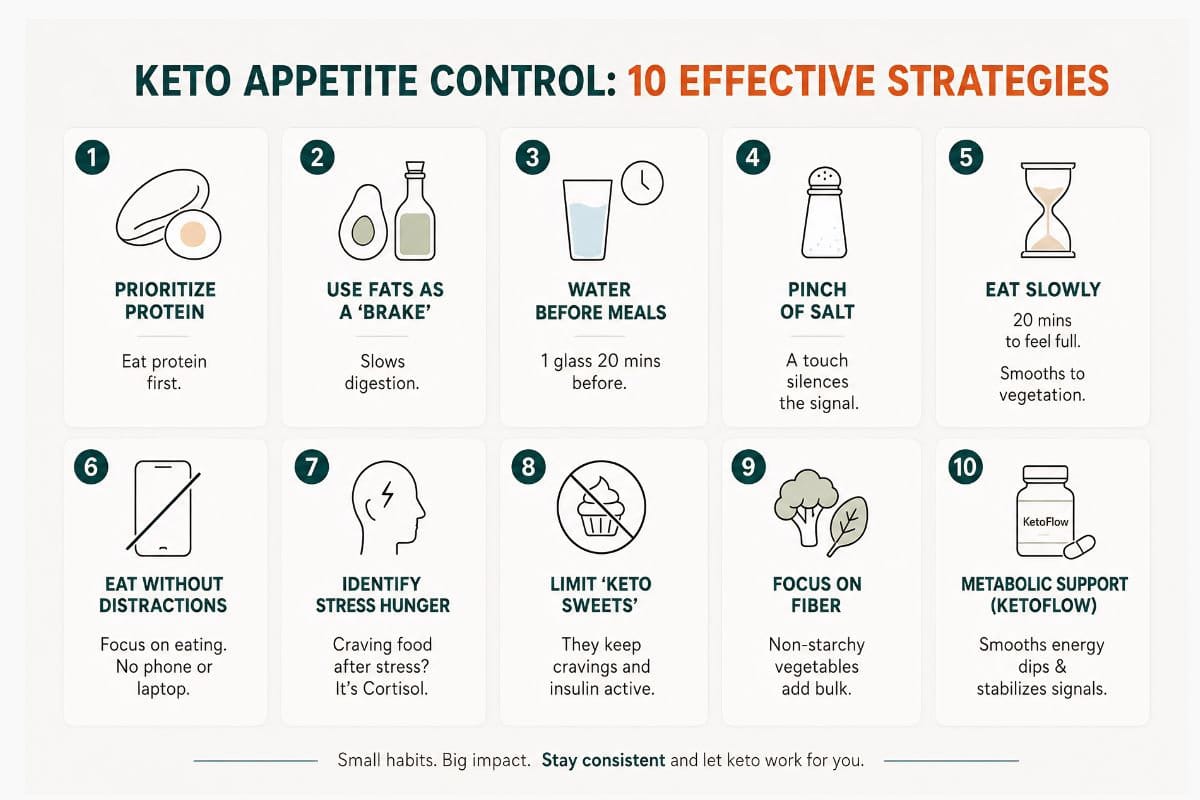
Ten small shifts, no fluff—just practical adjustments that work with your biology.
- Protein first: Eat it before anything else on your plate to trigger fullness signals.
- Fats as a brake: They slow digestion, helping you stay full longer without overeating.
- Water first: Thirst often mimics hunger; try a full glass 20 minutes before you eat.
- The salty pinch: Low sodium can feel like hunger; a pinch of sea salt often quiets it.
- Slow down: Your brain needs about 20 minutes to register that you're full.
- Eat without the phone: Paying attention helps your brain actually notice you're satisfied.
- Spot stress hunger: If you're reaching for food after a tough call, that's cortisol, not your stomach.
- Go easy on keto sweets: Artificial sweeteners can keep the craving loop active.
- Add fiber: Non-starchy veggies provide the bulk your stomach is looking for.
- Support the transition: Tools like KetoFlow can smooth out the rough spots when real food isn't quite enough.
Why Sleep is the Secret Weapon
Poor sleep raises ghrelin (the "I'm hungry" hormone) and lowers leptin (the "I'm full" hormone).
When you're tired, your brain craves quick energy—the easiest kind—and that's why one rough night can override even a perfectly planned keto day.
Prioritizing seven or eight hours isn't a luxury.
It's a metabolic foundation that makes everything else easier.
Where KetoFlow Fits
Those first weeks can feel clunky—your body's adjusting, hunger spikes at the worst times, and life doesn't pause while you figure it out.
That's where KetoFlow fits in, not as a fix but as a bridge to help you stay steady.
When your energy dips, everything gets harder, and KetoFlow helps keep things balanced.
It's a quiet signal to your brain that fuel is coming, even while your body's still learning to produce ketones efficiently.
Less decision fatigue, fewer restart cycles—it's not real food, but sometimes real food isn't quite enough in that moment.
Change the Signals, Change the Struggle
Hunger is just a signal, and if it's loud, your body's likely asking for more protein, salt, rest, or a little metabolic support.
These ten shifts won't make hunger disappear forever, but they'll help you stop fearing it and know exactly what to do when it shows up.
That's the real win: moving from struggle to calm, consistent progress.
Stop the next craving before it starts
The ClearKeto reset plan shows you exactly what to do — in under 60 seconds.
Download the free reset toolkit