
Why Am I Still Hungry on Keto? Causes and Fixes
You're eating the fat, skipping the carbs, doing everything right — and hunger keeps showing up anyway. Here's what's actually going on, and how to fix it without suffering through it.
You did the research. You bought the avocados, the heavy cream, the grass-fed butter. You've been careful with your carbs, consistent with your meals — and yet, there you are, standing in front of the pantry just an hour after lunch, with that gnawing, hollow feeling that simply will not go away.
It's maddening. You were told keto would quiet your appetite, that you'd forget to eat, that your body would happily run on fat and leave you feeling satisfied for hours. Instead, you feel like you're thinking about food more than ever. And somewhere in the back of your mind, a small, unkind voice starts suggesting that maybe your body is broken. That you're just one of those people who will always be hungry.
Persistent keto hunger is not a character flaw. It's a physiological signal — and signals can be adjusted.
Here's what we want you to hear: if you're experiencing persistent hunger on keto, it has nothing to do with willpower or discipline. It's a signal. Your body isn't trying to sabotage you — it's telling you that something in your nutritional setup is slightly off, and it would like you to fix it.
At ClearKeto, we don't believe in "toughing it out." We believe in adjusting the signal so that satiety becomes your natural baseline. Let's look at why the fat-heavy approach might be leaving you hungry, and which biological levers actually switch hunger off.
The "Fat-Forward" Mistake: Why Butter Alone Isn't Enough
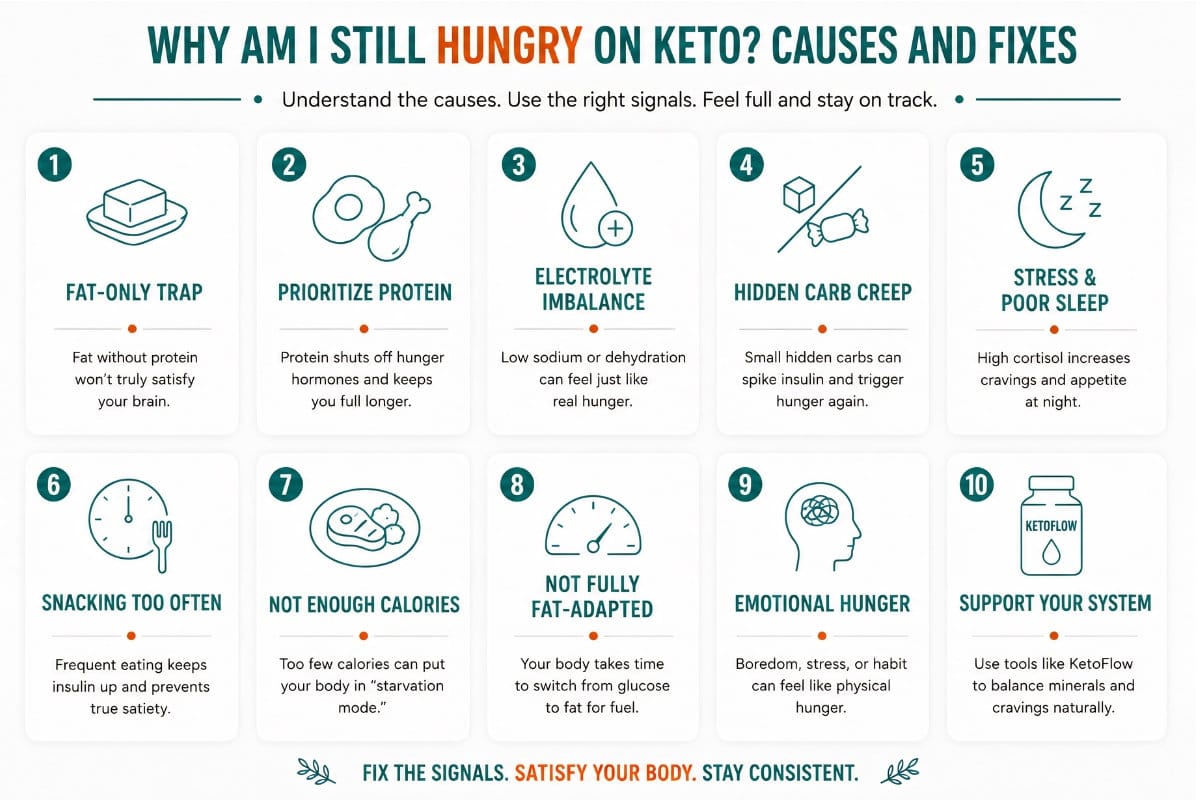
In the early days of keto, the message was often: fat is a lever — eat as much as you need to feel full. And while healthy fats are absolutely essential to the ketogenic approach, they are not the whole picture. There's a trap that catches a lot of women early on, and it has a name: The Fat-Only Trap.
It's a very common pattern — relying almost entirely on fat for satiety while unintentionally under-eating protein. And it feels logical on the surface. Fat slows digestion. It provides steady energy. It makes food feel rich and filling. So why does hunger come back so fast?
Because fat is excellent at keeping your stomach occupied, but it's not very good at sending immediate satiety signals to your brain. If you're eating fats without sufficient protein or micronutrients alongside them, your stomach might feel heavy — but your brain can still register something closer to starvation. It's still waiting for the signal that it actually got what it needed.
That signal requires amino acids. It requires minerals. Without protein, the hunger switch stays on, no matter how much butter you added to your coffee.
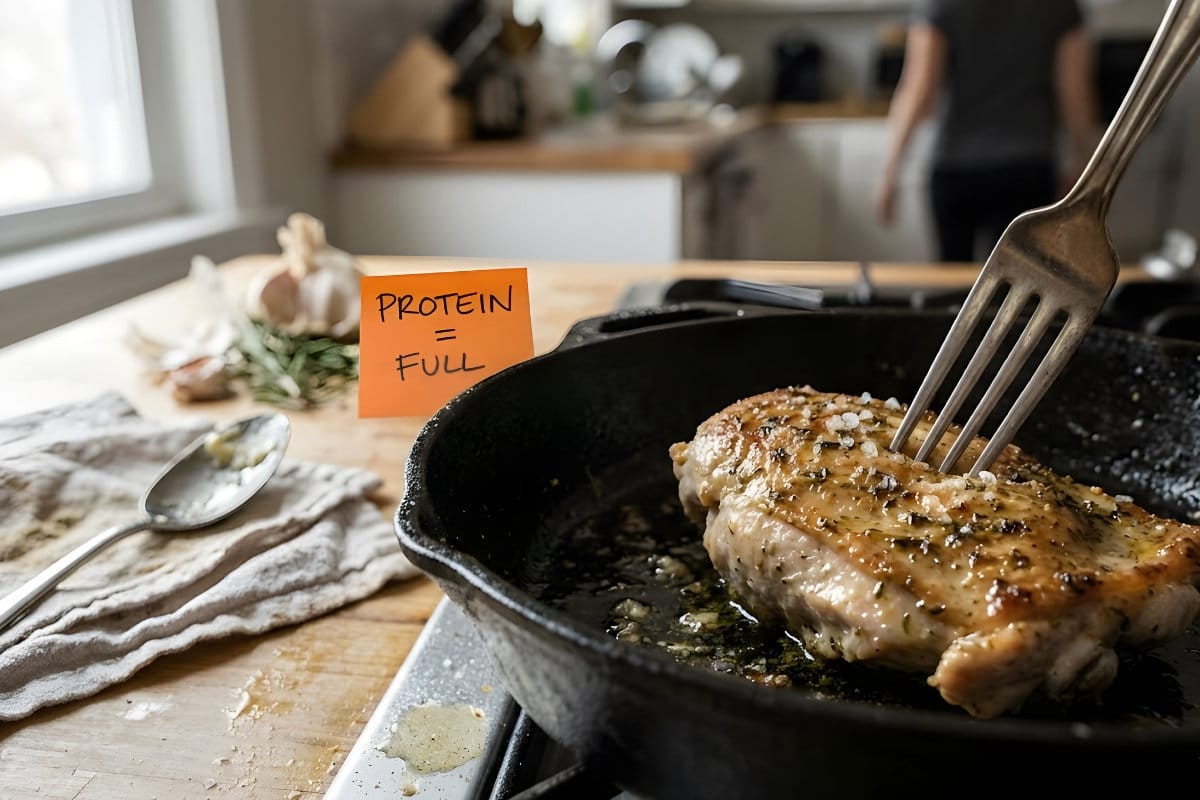
The Protein Lever: How to Actually Switch Off Hunger
There's a well-studied biological concept called the Protein Leverage Hypothesis. The short version: your body will keep feeling hungry until it has met a specific requirement for protein. It doesn't really care how many calories you've eaten. It cares whether the amino acid quota has been filled.
Think of hunger like a light switch. Fat and fiber can push it partway down — but the switch only clicks fully off when your body senses it has enough protein. That's when the fullness hormones — Cholecystokinin, Peptide YY — finally get their cue to quiet things down.
If you want to test this for yourself tonight, try a protein-forward meal and pay attention to how long you stay satisfied afterward. A simple chicken skillet with garlic butter, or a 15‑minute shrimp stir-fry — something built around real protein first, fat second. Most people notice a difference within a single meal.
Hunger switch logic:
Fat + fiber → halfway → still hungry
➕ Protein → switch OFF → true satiety
3 Hidden Reasons Your Body Thinks It's Starving
Sometimes the hunger has nothing to do with what's on your plate — and everything to do with what's happening around it. These three triggers get missed constantly, even by people who are otherwise doing everything right.
- The Electrolyte "Thirst": Low sodium mimics hunger almost perfectly. Before you reach for food, try a full glass of water with a pinch of sea salt. Wait ten minutes. You might be surprised how often the hunger just dissolves.
- Hidden Carb Creep: Even a small insulin spike — from hidden sugars in "keto-friendly" packaged snacks — can trigger a hunger response an hour later. If you're snacking on labeled products, check the ingredients, not just the carb count.
- The Sleep-Cortisol Loop: High cortisol from stress or poor sleep tells your body to find quick energy — fast. When you're exhausted, your brain's ability to resist cravings drops significantly. The hunger you feel at 3:00 p.m. on a bad night's sleep isn't really hunger. It's your stressed nervous system asking for relief.
Why Snacking Might Be Making You Hungrier
On keto, grazing is often the quiet enemy of satiety. Every time you eat — even something small — you trigger a mild insulin response. If you're eating constantly throughout the day, your insulin levels never drop low enough for your body to comfortably access its own fat stores. The result is a body that feels like it needs an external fuel top-up every couple of hours, because it never learned to reach inward.
Shifting toward two or three solid, protein-centered meals — and letting real hunger develop between them — often resolves what feels like unexplained, persistent hunger within just a few days. It's one of those changes that seems counterintuitive until you try it.
Hunger Is a Signal, Not a Flaw
You don't have to suffer to succeed on keto. If you're hungry — genuinely hungry — eat. But eat the things that actually satisfy the signal. Step back from the fat-only mindset and start putting protein at the center of the plate. Check your salt. Get the extra hour of sleep when you can. Give your body the amino acids, the minerals, and the breathing room it needs to regulate itself.
Your body is not broken. It's smart. When you give it what it's actually asking for, the hunger fades — not because you suppressed it, but because you answered it correctly.
For a deeper look at the biological triggers behind keto hunger — including how electrolytes, protein, and stress interact — the full breakdown is in the free toolkit below.
The complete hunger-fix protocol — including how to balance protein and electrolytes — is inside the free guide below.
Stop the hunger panic today
Download the STOP KETO CRAVINGS FAST Toolkit and get the 60‑second fixes and protein‑first meal templates you need.
Download the toolkit →